> For the complete documentation index, see [llms.txt](https://local.docs.ssaudit.com/llms.txt). Markdown versions of documentation pages are available by appending `.md` to page URLs; this page is available as [Markdown](https://local.docs.ssaudit.com/english-1/costing-method/7.3-coefficient-method.md).
# 7.3 Coefficient Method
The Coefficient Method applies to companies that produce similar products with different sizes or specifications. For example, glass bottles of 1L, 0.5L, and 250ml. One product is selected as the standard product, and other products are converted by coefficient.
> **Example:** Product A (1L) is the standard product (coefficient = 1), Product B (0.5L) has coefficient = 0.6, and Product C (250ml) has coefficient = 0.3.
>
> * Production in the period: A = 500 units, B = 800 units, C = 1,200 units
> * Converted to standard products: 500 x 1 + 800 x 0.6 + 1,200 x 0.3 = 500 + 480 + 360 = 1,340 standard units
The process includes 9 steps:
**Step 1 — Select the standard product and declare coefficients**
Declare the conversion coefficient for each product compared with the standard product. The system supports Excel import.
**Step 2 — Summarize finished goods produced in the period**
The system summarizes finished goods warehouse receipts.
**Step 3 — Summarize WIP and convert to equivalent finished goods**
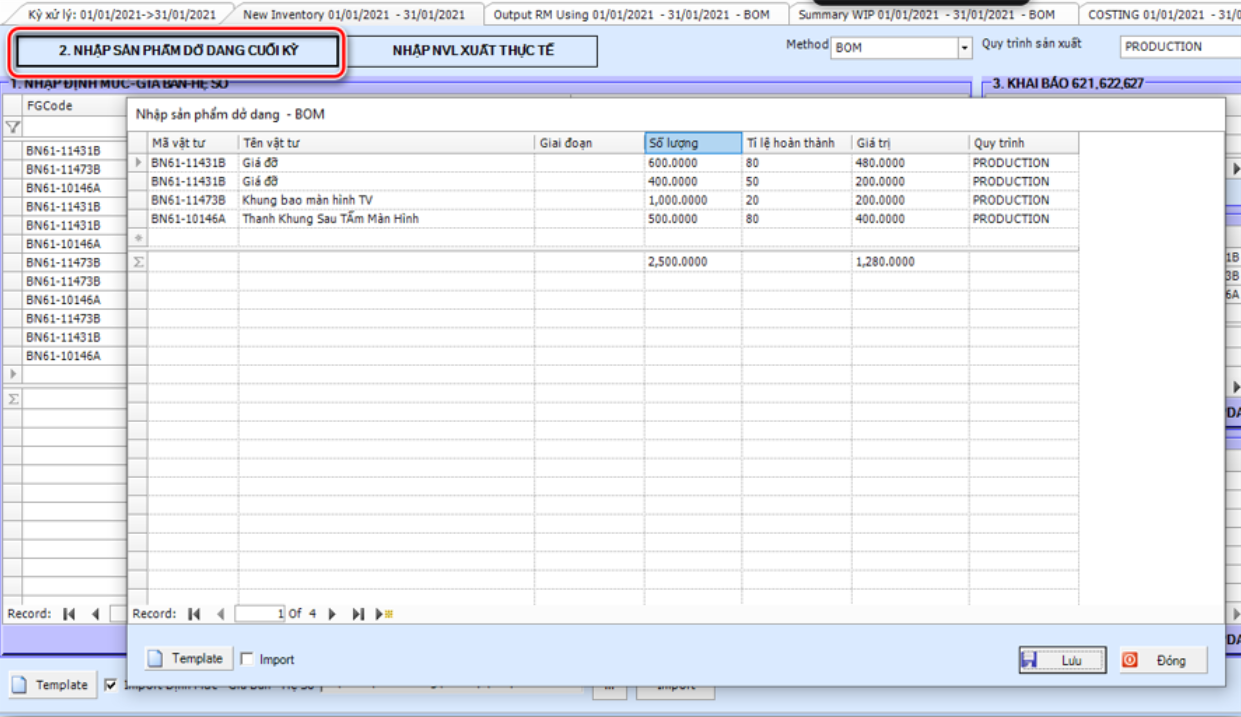
Enter ending WIP quantity and completion rate.
**Step 4 — Calculate products manufactured in the period**
> Products manufactured in the period = Finished goods + Ending WIP - Beginning WIP
**Step 5 — Convert products to standard products**
Multiply the manufactured quantity by the conversion coefficient declared in Step 1.
**Step 6 — Calculate the cost of the standard product**
> Standard product cost = (Beginning WIP + Costs incurred) / (Quantity produced in period + Beginning WIP quantity)
**Step 7 — Recalculate cost for each product type**
Multiply the standard product cost by each product's conversion coefficient.
**Step 8 — Calculate ending WIP value**
> Ending WIP value = Equivalent finished goods x Standard product unit cost
**Step 9 — Determine finished goods receipt value**
> Finished goods receipt value = Beginning WIP + Production costs incurred - Ending WIP
> **Note:** For other costing methods, see [Costing](/english-1/inventory-management-module/production-cost-calculation.md).